Artificial turf drains from the top down: rain passes through the turf into a base built to hold it and carry it away. Built well, that path keeps puddles off the lawn after a monsoon downpour. This guide explains what goes under the turf and what to ask an installer before you sign. Scottsdale Landscaping installs artificial turf and handles irrigation installation across the Scottsdale area.
Key Takeaways
- Plan a drainage path under any turf lawn, desert yard included; a dry climate is no reason to skip it.
- Choose turf with a backing that lets water through, because rain must clear the infill and backing before it reaches the base.
- Decide between a compacted aggregate base and drainage panels for your yard, since that layer carries the turf and passes water down.
- Make sure the soil under the base slopes away from your house toward a planned exit, so water never settles against a wall.
Do you need drainage under artificial turf?
Yes. Every artificial turf lawn needs a drainage path, even in a desert yard. Synthetic grass has no soil or roots to soak up rain or irrigation overspray, so water must pass down through the turf and its base, then leave the yard. When that path is missing or blocked, water sits under the backing (the turf’s underside). The base softens and the surface dips, so puddles linger after storms.
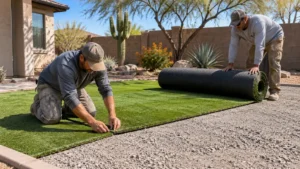
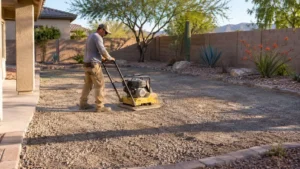
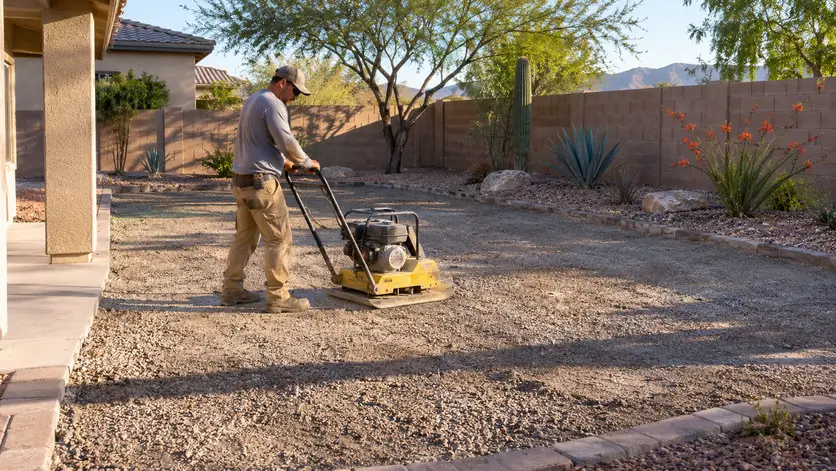
So drainage is planned into an artificial turf installation before any turf is rolled out. Our write-up of a Scottsdale turf installation shows the base going in; the Southwest Village project shows the same work nearby.
How does rain pass through the turf backing and infill?
Rain runs down between the turf blades, filters through the infill, then drops through the backing into the base below. Infill is the sand or rubber granules brushed in among the blades to hold them upright and weigh the turf down. Water moves through the gaps between those grains, so infill that stays loose keeps the path open.
The backing is where turf products differ. SYNLawn’s article on turf drainage describes two designs:
- Perforated backing: a solid backing punched with drainage holes, so water reaches the base only where a hole sits.
- Fully permeable backing: the whole backing lets water through, which the same article says passes water instantly and prevents pooling.
- Maximizes usability: Keeps lawns, playgrounds, and sports fields dry and ready for use—even after heavy rain.
SYNLawn says its own perforated backing is made so rainwater passes into the base at a specified drainage rate. That rate is set when the turf is manufactured, not by the installer.
Which base layers and drainage options go under the turf?
Most turf sits on one of two things: a compacted aggregate base laid over prepared soil, or drainage panels laid between the turf and what is below. The base carries the turf’s weight and lets water drop through. Panels add open space under the backing so water can also move sideways. Ultra Base, a maker of these panels, says its system leaves an open-channel air gap under the turf that moves water through faster than a compacted gravel base alone, and that storage built into each panel holds water until it soaks into the ground or runs to a drain.
| Compacted aggregate base | Drainage panels | |
|---|---|---|
| What goes down | Crushed rock spread and compacted in layers over graded soil | Interlocking plastic panels over a prepared base or a hard surface |
| How water leaves | Straight down through the stone into the soil | Down through the panels, then sideways through the gap beneath them |
| Where water waits | In the soil, at the rate it soaks in | In the panels’ built-in storage, per the maker |
| Ground it suits | Soil that takes water in | Soil that takes water in, or a surface that sheds it |
How do grading and exit points keep water away from your walls?
Grading tilts the soil beneath the base away from your house, so water that drops through the turf keeps moving toward a planned exit instead of settling against a wall. SYNLawn’s article on turf drainage calls for a 1 to 2% slope toward designated runoff areas. That slope belongs in the subgrade (the native soil shaped before any rock goes down), and not only on the finished surface. A level base laid over soil that leans toward the house carries the water straight back to the foundation.
An exit point is where that water leaves the turf: a lower edge opening onto a gravel strip, a yard drain, or a channel that carries it off the lot. Whichever it is, it has to sit lower than the turf.
Look closely where turf meets stucco or a raised bed. If the grade runs toward that edge, water collects against the wall after each storm instead of leaving.
Monsoon storms and desert soil: what changes in Scottsdale-area yards
In Scottsdale-area yards, the deciding question is how fast the soil under the base takes in water, and that can differ from one lot to the next. A monsoon downpour can push water through the turf faster than slow soil absorbs it, so the base must store it or carry it to the exit. A percolation test answers this. First request a utility locate through Arizona’s one-call service and wait for buried lines to be marked; then dig a hole where the turf will go, fill it with water, and time the drain. Slow results favor a base that moves water sideways.
What should you ask an installer about drainage before you sign?
Ask for the drainage plan in writing, in terms you can check against your yard. These questions cover what earlier sections explain:
- Which way will the subgrade slope, and where does water leave the turf?
- Will you test how fast my soil drains before choosing the base?
- Aggregate base or drainage panels, and why for this yard?
- Which turf backing are you quoting, perforated or fully permeable?
- How will you handle edges next to walls and raised beds?
If an answer stays vague, get another quote.
What turf drainage problems are common, and how do you prevent them?
The problems below show up after the turf is down, when something blocks or overloads the drainage path. Each is easier to head off during installation than to fix later.
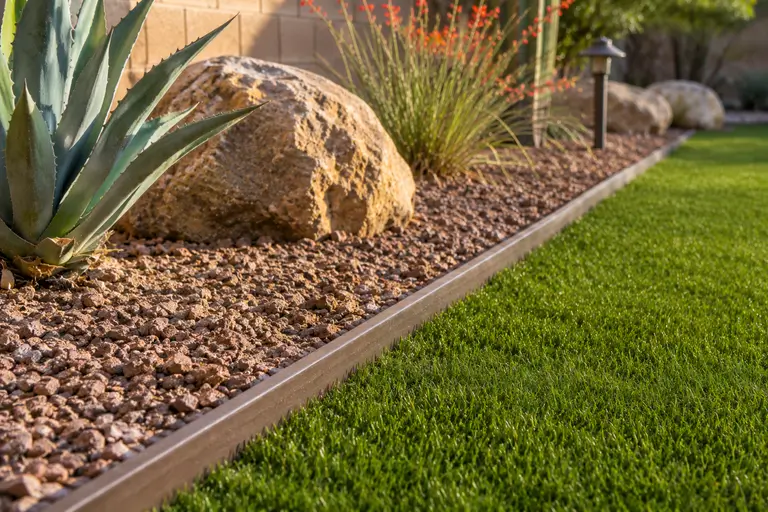
- Soil washing onto the turf. A planting bed set higher than the turf sheds silt and mulch into the infill with each storm, filling the gaps that water drains through. Edging or a low curb between bed and turf keeps that debris out.
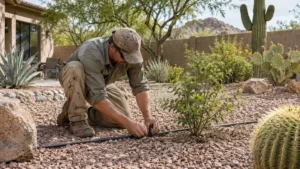
- Sprinklers soaking the base. Spray heads that throw onto the turf keep the base wet between storms. Capping or redirecting those heads before the turf goes in stops it.
- A surface that ripples or sinks. Loose joints or gaps in the layer under the backing let it shift. Ultra Base says its drainage panels lock together at 24 interlocking connections for a flat surface without the “honeycomb voids” it attributes to competing drain tile.
If you are still weighing the benefits of artificial turf for your yard, that page covers that question. To talk through drainage for your own lot, contact Scottsdale Landscaping or call 602-894-9141.
Sources
- Does Artificial Turf Drain Well? | SYNLawn Blog, synlawn.com, retrieved 2026-10-29.
- Ultra Base | The Ultimate Artificial Grass Drainage Technology, ultrabasesystems.com, retrieved 2026-10-29.