A drip system is the watering setup that fits a Scottsdale yard, keeping desert trees and shrubs healthy through the long hot months. This guide covers how drip works in desert ground and which type of system suits your yard. It also weighs the drawbacks of switching, what a sound installation includes, what sets the price, and whether to hire an installer.
Key Takeaways
- Plan drip around your plants: emitters release water slowly at each plant’s base instead of throwing it across rock and pavement.
- Learn the difference between separate emitters and dripline with emitters built in, since each is made for a different kind of planting.
- Choose the system for your own yard: plant spacing and whatever else shares that ground decide which type will work.
- Expect drip to fail without warning, so check emitters and lines on a schedule instead of waiting for a dry shrub to tell you.
What is drip irrigation and how does it water a desert yard?
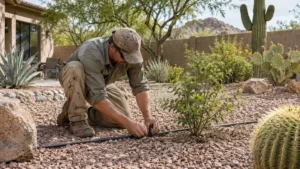
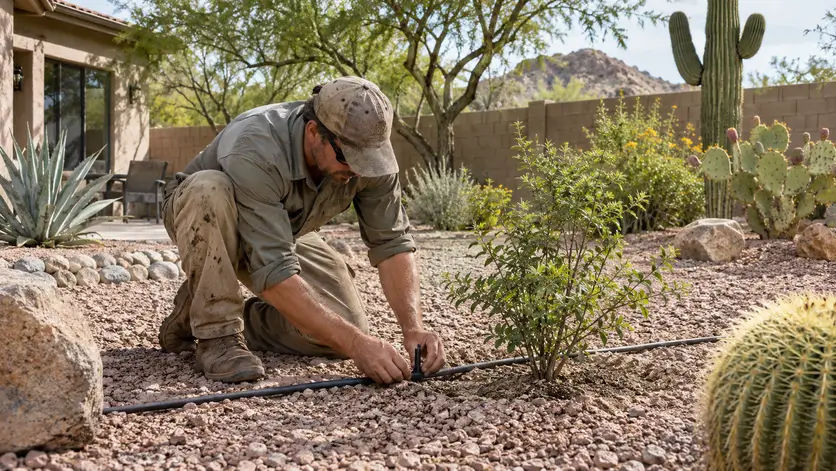
Drip irrigation is the slow, measured application of water through small devices called emitters, which release water at the base of a plant instead of spraying it over the yard. The University of Arizona Cooperative Extension’s guide to drip basics explains that it puts water directly into the root zone of desert landscape plants. Because it soaks in slowly, little is lost to runoff or evaporation compared with sprinklers. You may also see it sold as low-flow or micro irrigation.
The EPA’s WaterSense program recommends drip for watering trees, shrubs and flowers in water-scarce climates to cut outdoor water waste. It also points out that plants matched to a site’s water conditions need less supplemental irrigation to begin with.
What are the main types of drip systems?
Drip systems differ mainly in how water leaves the tubing: through separate emitters, through emitters built into the line itself, or through a line buried under the soil.
| Type | How it delivers water | Built for |
|---|---|---|
| Point-source emitters | Individual emitters punched into supply tubing, one or more per plant | Spaced-out trees and shrubs |
| Inline dripline | Emitters molded into the tubing at a set spacing | Dense beds and hedge rows |
| Subsurface drip | Dripline buried so water releases below ground | Beds where surface tubing would be in the way |
| Bubblers | Low-flow heads that flood a small basin | Watering a single tree well |
Which type of drip system suits Scottsdale plants and yard layouts?
No one type suits every Scottsdale yard. The right choice depends on how your plants are spaced and what else shares the ground with them. A yard with a few trees spread across gravel and a packed shrub bed by the front door may need point-source emitters for the trees and inline dripline for the bed.
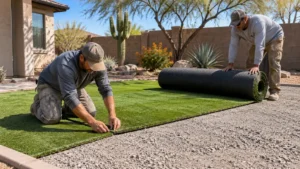
Hardscape decides where tubing can run. Tubing that crosses a walkway or patio is easiest to pass through a sleeve laid before the pavers go down, and ground planned for artificial turf needs no drip at all. So a drip layout works best when it is drawn up alongside the design, paver and turf work planned for the property. Scottsdale Landscaping handles drip system design and installation in Scottsdale and nearby cities.
What are the downsides of switching to drip irrigation?
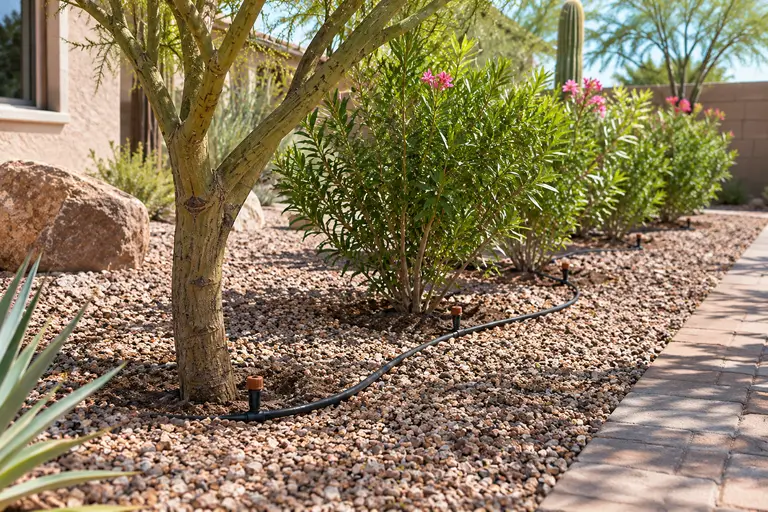
Drip has a catch: it fails quietly. A clogged emitter or a line pulled loose under the rock gives you no geyser to spot, so a shrub can go dry well before it shows stress. Tubing near the surface also gets nicked by shovels and dug up by pets. Established plants are another concern, since their roots grew wherever the old sprinklers wet the soil. Before switching, ask how you will check each plant’s emitters and how the layout reaches the roots of mature trees.
What a proper drip installation involves: zones, valves, filters and pressure
A proper drip installation puts drip on its own zones and valves, then adds a filter and a pressure regulator so the emitters get clean water at the pressure they were made for. It also needs a backflow preventer on the irrigation supply, which keeps yard water from flowing back into the home’s drinking water lines. The University of Arizona Cooperative Extension’s drip basics guide explains that sprinklers and drip apply water at different rates and run under different pressure, so they need separate valves. That affects any conversion. Every sprinkler on the same zone and valve has to change to drip. You cannot convert one bed and leave a spray head on that circuit.
Filtration matters in Arizona, where hard water clogs emitters. The extension’s seasonal maintenance guide for Arizona drip systems treats a drop of 3 to 7 PSI (pounds per square inch) across the filter as normal and says to investigate anything above 12 PSI. Ask for a written record of the zone layout too. It makes adding emitters easier as your plants grow.
What drives the cost of a drip irrigation system?
A drip system’s price follows the area it covers and the number of zones it needs. Whether the dripline runs on the surface or is buried also matters, as do the quality of the parts and whether you install it yourself. Labor rates differ from one area to another as well.
Nationally, HomeGuide’s drip irrigation cost guide puts typical above-ground drip at $1.50 to $4.50 per square foot or $300 to $1,200 per zone installed, subsurface dripline at $1,000 to $4,000 per acre, and DIY kits at $15 to $480 depending on the area covered. HomeGuide (cost guide) does not say whether that figure includes the material itself. LawnStarter’s sprinkler system cost guide gives a typical national drip installation as $1,191 to $2,918 including materials and labor, without stating the yard size it covers. LawnStarter’s guide also puts in-ground sprinklers at $0.90 to $1.70 per square foot. LawnStarter’s prices leave out permit and inspection costs.
Should you install drip irrigation yourself or hire an installer?
A single, self-contained bed is a reasonable weekend project to do yourself. Converting existing sprinkler zones or laying out drip for a whole yard is usually worth handing to an installer. The tubing end of the job is forgiving. Dripline cuts with pruners and emitters push in by hand, so a mistake in one bed costs little to redo.
The harder work happens upstream of the tubing. That means opening the valve manifold and wiring new zones to the controller. It also means sizing each zone so the emitters at the far end get as much water as the ones near the valve, and that takes some planning before the first trench.
If you would like help deciding whether your project calls for an installer, get in touch with Scottsdale Landscaping or call 602-894-9141.
Sources
- Landscaping Tips | US EPA, U.S. Environmental Protection Agency (WaterSense), retrieved 2026-10-29.
- The Basics of Drip Irrigation for Landscaping | UA Cooperative Extension, extension.arizona.edu, retrieved 2026-10-29.
- Seasonal Maintenance Practices for Drip and Sprinkler Irrigation Systems in Arizona, extension.arizona.edu, retrieved 2026-10-29.
- How Much Does a Drip Irrigation System Cost to Install? (2026), HomeGuide (cost guide), retrieved 2026-10-29.
- How Much Does a Sprinkler System Cost in 2026?, lawnstarter.com, retrieved 2026-10-29.